
Meta Ads Update: “Describe Your Audience” Signals a Shift Toward AI-Driven Targeting Meta Description
Douce
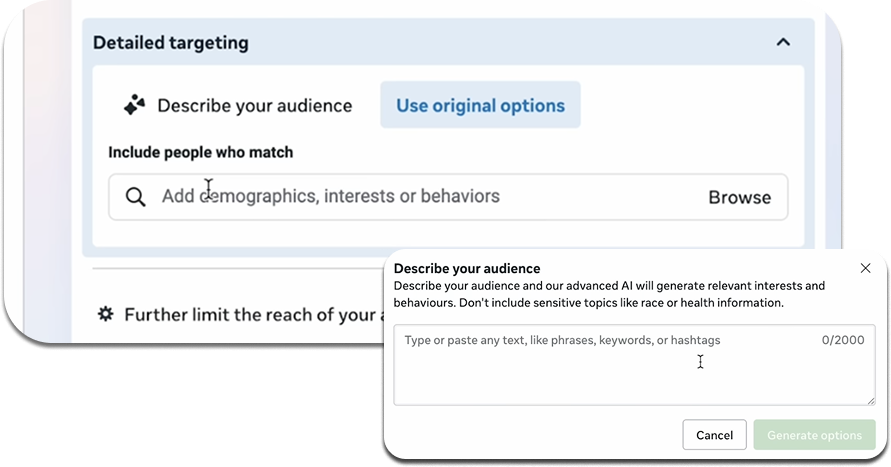
Meta has recently begun testing a new feature within Ads Manager labeled “Describe your audience.”
Based on the current interface, advertisers can input keywords, phrases, or behavioral descriptions, and Meta’s system will automatically generate relevant audience targeting options.
The feature is currently in a testing phase, with limited availability across accounts and functionality that is still evolving.
From Selecting Interests to Describing Audiences
Traditionally, advertisers on Meta platforms have relied on manual targeting by:
- Selecting interests
- Layering behavioral signals
- Applying demographic filters
This process can be time-consuming and requires familiarity with Meta’s targeting taxonomy.
With the new feature, advertisers can instead describe their intended audience using natural language. For example:
“People interested in jewelry, gifting, luxury lifestyle, and online shopping.”
Meta’s AI then interprets this input and translates it into a set of relevant targeting parameters.
This effectively shifts the burden of audience construction from the advertiser to the algorithm.
How the Feature Works
According to the current UI, the feature allows advertisers to:
- Enter keywords or descriptive phrases
- Provide behavioral or interest-based signals
- Let the system generate audience suggestions automatically
Meta’s system appears to analyze semantic meaning and intent, mapping it to existing interest and behavior categories behind the scenes.
While the exact logic remains undisclosed, the approach reflects a broader move toward AI-assisted campaign setup.
Current Status: Limited Rollout and Incomplete Functionality
At this stage, the feature remains in beta and presents several limitations:
- Limited access: Only available to select ad accounts
- Incomplete functionality: Output quality and consistency may vary
- Low transparency: The mapping between input and targeting remains unclear
As a result, it is not yet positioned as a full replacement for existing targeting strategies.
A Broader Industry Shift Toward AI-Driven Targeting
This update aligns with Meta’s ongoing efforts to automate and simplify advertising workflows. Previous developments include:
- Broad targeting expansion
- Advantage+ campaigns
- Increased reliance on algorithmic optimization
The introduction of “Describe your audience” further reinforces a clear direction:
from manual, selection-based targeting
to AI-driven, intent-based audience modeling
This suggests that platforms are moving beyond predefined categories toward interpreting advertiser intent directly.
Implications for Advertisers
The shift introduces several potential changes for advertisers:
Lower barrier to entry
Advertisers no longer need deep knowledge of targeting categories to build audiences.
Increased efficiency
Automated matching may reduce setup time and improve relevance.
Greater reliance on input quality
The effectiveness of campaigns may depend more heavily on how clearly audiences are described.
Reduced manual control
As automation increases, direct control over audience composition continues to decrease.
Benefits and Challenges
Potential benefits
- Simplified campaign setup
- Faster audience creation
- Reduced wasted ad spend
Potential challenges
- Limited transparency in AI decision-making
- Variability in performance during early stages
- Reduced visibility into audience composition
A Shift in Core Advertising Capabilities
Beyond the feature itself, a more significant change is emerging in how advertising performance is driven.
Historically, success depended on:
precise interest selection and audience segmentation.
Going forward, it may depend more on:
- clearly defining the target audience
- providing strong creative signals
- aligning messaging with user intent
In this context, the role of the advertiser shifts from operator to strategist.
Douce Insight
We see this development as part of a broader transition in digital advertising.
Platforms are reducing operational complexity while increasing the importance of strategic clarity and creative quality.
“Describe your audience” is an early indicator of this shift.
In an AI-driven advertising environment, competitive advantage will increasingly come from:
- a clear understanding of the target audience
- the ability to articulate that audience effectively
- and a well-structured, full-funnel marketing approach
For brands navigating these changes, adapting to platform evolution will be key to maintaining performance and efficiency.