
Lifecycle Marketing: A Complete Guide to Driving Long-Term Growth
Douce
In today’s increasingly competitive landscape, acquiring new customers is no longer enough. Rising acquisition costs and fragmented user attention have made it essential for brands to shift their focus beyond one-time conversions.
This is where lifecycle marketing comes in.
Lifecycle marketing is not just a tactic—it is a comprehensive growth strategy that engages users across their entire journey, from first interaction to repeat purchase and long-term advocacy. When executed effectively, it enables brands to maximize customer lifetime value (LTV), improve retention, and build sustainable revenue streams.
What is Lifecycle Marketing?
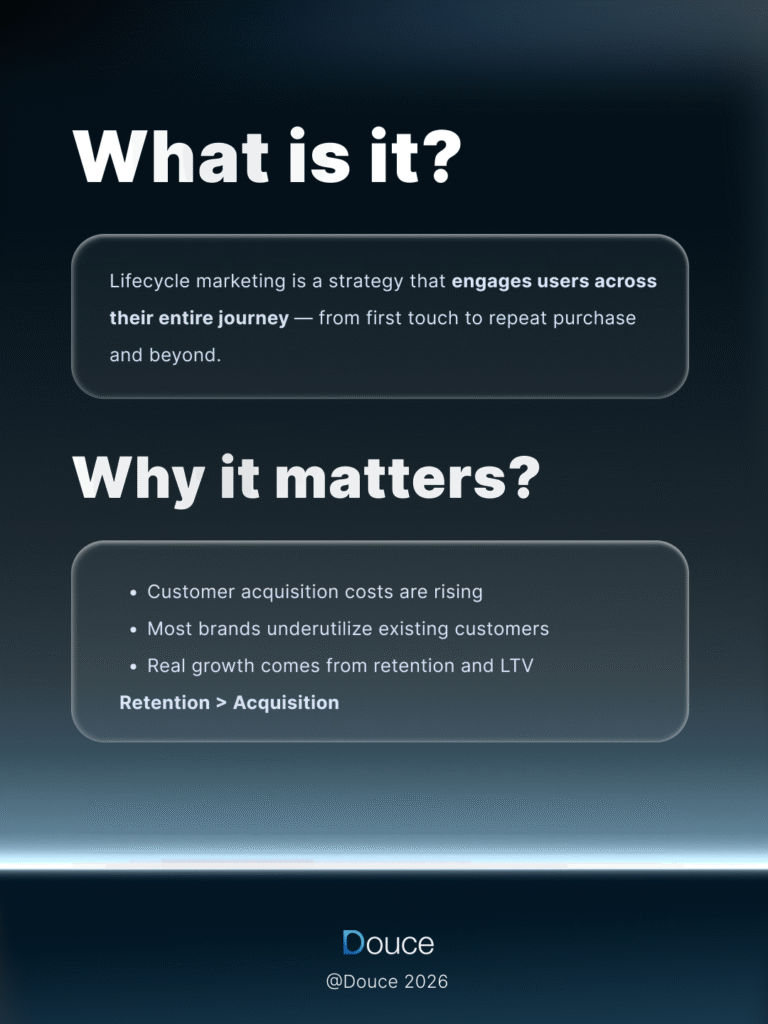
Lifecycle marketing refers to the practice of engaging customers at every stage of their journey with tailored messaging, channels, and experiences.
Rather than treating each campaign as an isolated effort, lifecycle marketing builds a connected system that responds to user behavior, preferences, and timing.
It is not about driving a single conversion—it is about building long-term customer relationships.
Why Lifecycle Marketing Matters
Many brands still allocate the majority of their budget to acquisition. However, this approach often overlooks the most valuable asset they already have: existing customers.
Key challenges brands face today:
- Customer acquisition costs continue to rise
- Conversion rates are becoming harder to optimize
- Retention strategies are often underdeveloped
Lifecycle marketing addresses these challenges by focusing on:
- Increasing repeat purchase rates
- Extending customer lifetime value (LTV)
- Building stronger brand loyalty
In simple terms: retention drives sustainable growth.
The Lifecycle Marketing Funnel
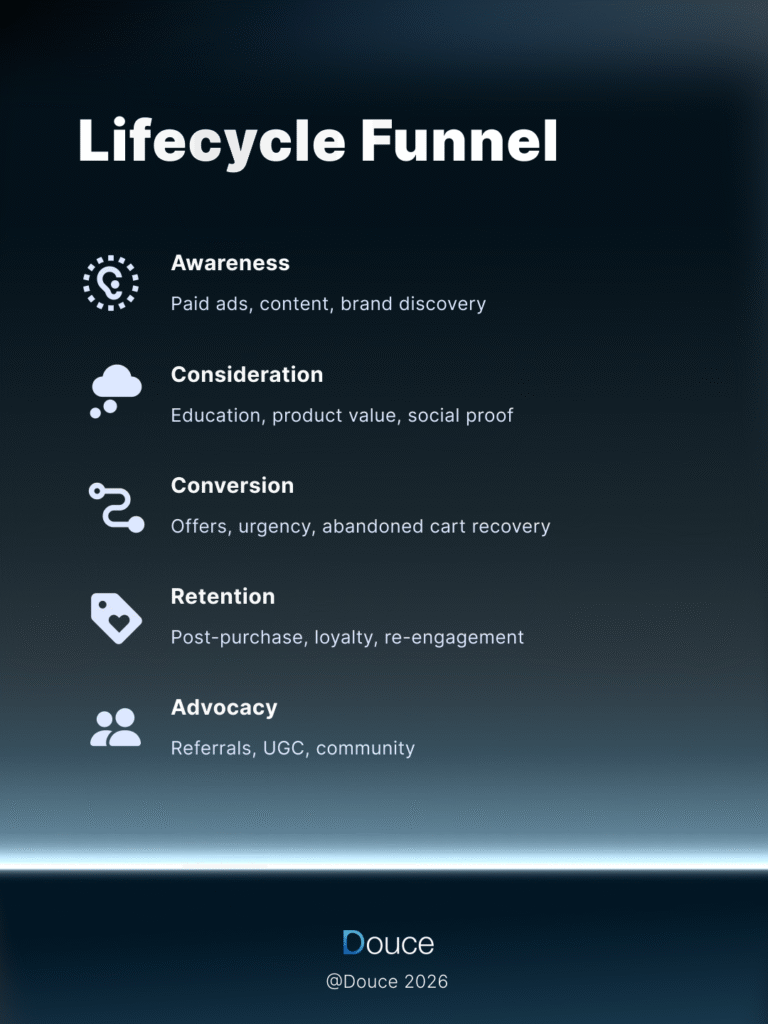
Lifecycle marketing is typically structured around five key stages:
- Awareness
- Consideration
- Conversion
- Retention
- Advocacy
Each stage represents a different user mindset and requires a distinct strategy, messaging approach, and set of channels.
Stage 1: Awareness
At this stage, the goal is to introduce your brand to potential customers and generate initial interest.
Key strategies:
- Paid advertising (Meta, TikTok, Google)
- Organic content (social media, SEO, blogs)
- Influencer and creator collaborations
Case example: A DTC jewelry brand leveraged TikTok creators to generate short-form content showcasing product styling. Combined with paid amplification, this increased top-of-funnel traffic by over 60% within two months.
Stage 2: Consideration
Once users are aware of your brand, the focus shifts to building trust and helping them evaluate your offering.
Key strategies:
- Educational content and product storytelling
- Email capture (welcome flows, lead magnets)
- Social proof (reviews, testimonials, UGC)
Case example: A skincare brand implemented a structured email welcome series with educational content and ingredient transparency. This resulted in a 35% increase in conversion rate among new subscribers.
Stage 3: Conversion
At the conversion stage, the objective is to turn interested users into paying customers.
Key strategies:
- Limited-time offers and promotions
- Abandoned cart recovery flows
- Retargeting ads based on user behavior
Case example: An e-commerce brand introduced a multi-step abandoned cart flow (email + SMS), achieving a 22% recovery rate and significantly improving revenue efficiency.
Stage 4: Retention
Retention is where lifecycle marketing begins to deliver its strongest impact. The focus here is to keep customers engaged and encourage repeat purchases.
Key strategies:
- Post-purchase email and SMS flows
- Loyalty and rewards programs
- Personalized product recommendations
Case example: A subscription-based wellness brand implemented replenishment reminders and personalized upsell emails, increasing repeat purchase rate by 40% over a six-month period.
Stage 5: Advocacy
The final stage transforms satisfied customers into brand advocates.
Key strategies:
- Referral programs
- User-generated content (UGC)
- Community building (e.g., Discord, private groups)
Case example: A tech accessories brand built a Discord community for its users, encouraging product discussions and UGC sharing. This led to a measurable increase in organic referrals and reduced reliance on paid acquisition.
Channels & Touchpoints in Lifecycle Marketing
A strong lifecycle strategy is inherently multi-channel. Relying on a single channel limits both reach and effectiveness.
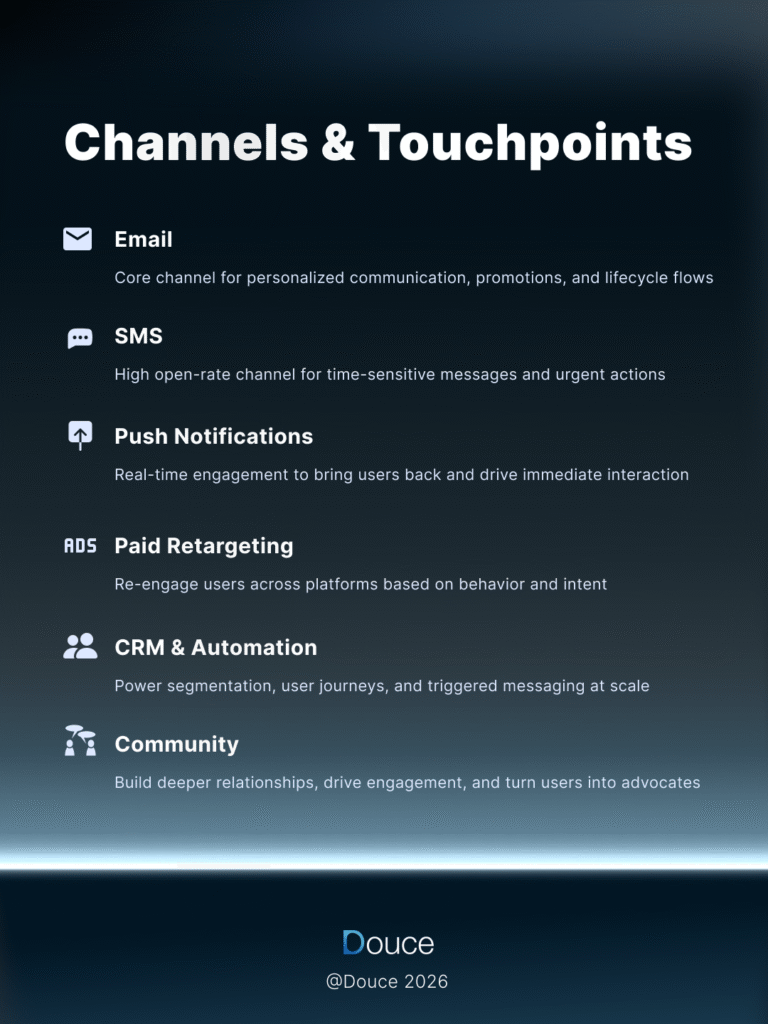
Core channels include:
- Email: Personalized communication, lifecycle flows, and promotions
- SMS: High-impact, time-sensitive messaging
- Push notifications: Real-time engagement and reactivation
- Paid retargeting: Re-engaging users based on behavior and intent
- CRM & automation: Segmentation, data management, and triggered journeys
- Community platforms: Building deeper engagement and long-term loyalty
The key is not just using these channels—but orchestrating them into a cohesive system.
Building an Effective Lifecycle Marketing System
An effective lifecycle marketing system is built on three core pillars:
1. Data & Segmentation
Understanding user behavior and segmenting audiences is foundational. This allows brands to deliver relevant and timely messaging.
2. Automation & Journeys
Automated flows ensure that users receive the right message at the right time, without requiring constant manual effort.
3. Continuous Optimization
A/B testing, performance tracking, and iterative improvements are essential to maximizing results over time.
Lifecycle marketing shifts the focus from short-term wins to long-term growth. It connects acquisition, conversion, and retention into a unified strategy—turning one-time buyers into loyal customers and advocates.
Brands that invest in lifecycle marketing are not just running campaigns—they are building scalable, revenue-generating systems.
How Douce Can Help?
Douce specializes in building end-to-end lifecycle marketing systems tailored to each brand’s unique audience and growth goals.
From customer segmentation and automated flows to cross-channel strategy and retention optimization, we help brands turn fragmented marketing efforts into a cohesive, high-performing growth engine.
If you’re looking to move beyond one-off campaigns and build a sustainable lifecycle strategy, our team brings both the strategic expertise and hands-on execution to make it happen.
Let’s build a system that drives long-term growth.